


Is Your Home Working Against You? How Layout Quietly Shapes Your Stress Level
You walk through the front door after a long day. Nothing is obviously wrong. The house is tidy enough. The furniture is nice. And yet — something feels off. A low-level tension you can’t quite name, a restlessness that follows you from room to room.
You might attribute it to the day you’ve had. But what if it’s the home itself?
Your Brain Is Always Reading the Room
Long before you consciously register whether you like a space, your brain has already rendered a verdict. The amygdala — the brain’s threat-detection center — scans your environment within milliseconds of entry, processing spatial cues, light levels, visual complexity, and flow. It asks three questions in rapid succession: Is this safe? Is this overwhelming? Can I relax here?
This happens entirely below conscious awareness. Which means a poorly designed layout doesn’t just feel uncomfortable — it keeps your nervous system on quiet alert, all day, without you ever pinpointing why.
This is the premise of neuroarchitecture: that the built environment is not a passive backdrop to daily life, but an active participant in your physiology. Research published through the National Institutes of Health confirms that architectural features — ceiling height, sightlines, circulation patterns, and material choices — produce measurable changes in cortisol levels, heart rate, and brainwave activity. The design of your home is either working for your nervous system, or against it.
The Patterns That Quietly Drain You
Poor layouts tend to tax the brain in a few predictable ways.
Circulation that constricts. Dark, linear corridors with no visual variation create a sense of monotony and confinement that researchers have linked to elevated stress and depressed mood. Movement through your home should feel intuitive — effortless, almost instinctive. When it doesn’t, the body is working harder than it should to navigate what should be the most familiar terrain.
Visual chaos that registers as threat. Cluttered sightlines are more than an aesthetic issue. Research published in the Personality and Social Psychology Bulletin found that people living in visually disorganized spaces showed flattened cortisol slopes throughout the day — a hormonal signature of chronic, low-grade stress. Every out-of-place object registers in the brain as an unfinished task. Multiply that across a full day of living, and the cumulative cost is real.
Spatial transitions that offer no relief. Most homes move people abruptly from one activity zone to the next — from busy to quiet, from work to rest — without any architectural buffer in between. The nervous system doesn’t shift gears on command. It needs a signal, a moment of designed pause, to begin the process of letting go.
The Layer You Don’t See
Beyond layout, three sensory factors quietly shape your stress profile in ways most homeowners never connect back to design.
Insufficient natural light forces the eyes to work harder, disrupts circadian rhythm, and keeps the body subtly out of sync with the natural day. Background noise — even at low levels — triggers a measurable cortisol cascade and has been linked over time to cardiovascular and metabolic strain. And degraded indoor air quality impairs cognitive function in ways that feel like fatigue, distraction, or low mood — rarely recognized for what they actually are.
Deficiency in one compounds the others, creating an invisible environmental load that quietly drains your capacity to think clearly, rest deeply, and feel at ease in your own home.
What It Looks Like When It Works
A few years ago, we worked with a high-powered couple who wanted their primary bedroom to function as a genuine sanctuary — not just aesthetically, but neurologically. True restoration, not just a well-appointed room.
Rather than connecting the bedroom directly to the main circulation of the house, we designed a glass-walled hallway between the two — a decompression chamber. A quiet architectural pause. The transition from the energy of the household to the calm of the bedroom is not abrupt; it is a passage, a deliberate signal to the nervous system that the demands of the day are behind you.
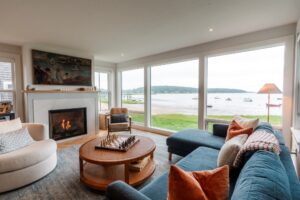
We also reoriented the bedroom itself — shifting its axis away from the main house to face a small pond on the property. The result was a space that is genuinely serene. Water in the sightline. Stillness in the air. A layout that made rest feel like the only logical thing to do.
The science behind this is well established. Dr. Wallace Nichols’ Blue Mind research demonstrates that proximity to water — even a quiet pond view — produces measurable increases in alpha brainwave activity, the brain’s calm, meditative state, alongside meaningful reductions in cortisol. The pond wasn’t simply beautiful. It was doing neurological work.
Your Home Should Be Your Greatest Asset
Architecture tuned to the way the brain works doesn’t happen by accident. It requires deliberate attention to flow, light, transition, material, and orientation — and a genuine understanding that the home is not just a container for your life, but an active participant in it.
The most high-performing people we know invest carefully in what they put into their bodies, how they move, and how they rest. The home is the environment where all of that either flourishes or doesn’t. When it is designed thoughtfully — finely tuned to the way you think, feel, and live — the difference is not subtle.
If your home has been quietly working against you, it’s worth finding out why.
Sources:
-
National Institutes of Health / PMC:Neuroarchitecture: How the Perception of Our Surroundings Impacts Our Wellbeing— pmc.ncbi.nlm.nih.gov/articles/PMC11048496
-
Personality and Social Psychology Bulletin: Cortisol response to cluttered home environments
-
Architecture Psychology:Could the layout of your home be harming you?— architecturepsychology.org/home-layout-psychology
-
Dr. Wallace J. Nichols / Neurosity:What Is Blue Mind Theory? Water and Restoration— neurosity.co/guides/blue-mind-theory-water-mental-restoration
-
iMotions:Feeling at Home: How to Design a Space Where the Brain Can Relax— imotions.com/blog/insights/trend/brain-feel-at-home
-
dSPACE Studio:Neuroarchitecture: Wellness by Design— dspacestudio.com/post/neuroarchitecture-wellness-by-design